Gonneville Project
Our focus is Chittering.
The Gonneville mine is outside the Shire of Chittering, but that does not mean its potential impacts stop at our boundary.
The Shire does not determine whether the mine itself is approved. However, where aspects of the mine may affect Chittering residents or our district, the Shire will seek to understand those potential impacts, advocate for Chittering's interests and participate in relevant assessment processes where the Shire has an appropriate role.
Some matters, such as potential health or environmental effects from mine operations, require specialist assessment by the responsible State or Commonwealth authorities. The Shire will use those processes to advocate for Chittering, rather than attempt to duplicate the role of specialist regulators.
The Shire also has a more direct role in advocating about infrastructure and transport proposals within Chittering, where the potential effects on our residents, landholders, environment, roads and the Chittering Valley are immediate and significant.
Council's focus is therefore not determined simply by which side of the Shire boundary an activity occurs. It is on protecting Chittering's interests and directing our effort to where it can make a meaningful difference.
Frequently Asked Questions
Why has the Shire prepared these FAQs?
The proposed Gonneville Project and its associated infrastructure have generated significant interest and concern within the Chittering community.
The Shire recognises that there is uncertainty about what Council has done, which matters the Shire can influence, and which decisions sit with State and Commonwealth authorities.
The proposed mine is not located within the Shire of Chittering. However, dust or other effects from the mine itself may be raised as potential cross-boundary concerns, while proposed infrastructure and transport corridors may directly affect land and roads within Chittering.
Potential effects on Chittering should not be disregarded simply because the mine site is outside the Shire. Residents and community organisations can raise those matters directly through the relevant State and Commonwealth assessment processes. The Shire will consider whether there is also a broader Chittering interest that warrants a separate Council submission or advocacy position.
Council’s focus is on advocating for the interests of affected residents and landholders, the protection of Chittering’s natural environment and rural landscape, the safety and suitability of local roads, community wellbeing, Shire assets and ratepayers.
Understanding the project and the Shire’s role
What is the Gonneville Project?
The Gonneville Project is a proposed critical-minerals development involving nickel, copper, cobalt and platinum group elements.
The proposal includes the mine itself, and associated infrastructure required to support its development and operation.
The proposed mine site is located in the Shire of Toodyay. However, power, water and access infrastructure has been investigated through the Shire, and project transport options may affect roads within Chittering.
Is the proposed mine in the Shire of Chittering?
No.
The proposed mine is in the Shire of Toodyay and its approval is determined through State and, where applicable, Commonwealth processes.
However, potential environmental, health or community effects do not necessarily stop at local government boundaries.
Residents and community organisations can raise mine-related concerns directly through the relevant assessment processes. The Shire may also make submissions or undertake advocacy where a matter affects the broader interests of Chittering.
The Shire has a more direct interest in the infrastructure and transport proposals within Chittering, including potential effects on:
- affected landholders and rural-residential communities;
- vegetation, habitat and threatened flora;
- the Chittering Valley landscape and rural amenity;
- local roads, road safety and emergency access;
- tourism and the visitor experience;
- community wellbeing; and
- Shire assets and ratepayers.
Does the Shire decide whether the Gonneville mine is approved?
No. The Shire can provide relevant local information, make submissions and advocate for Chittering's broader interests. Residents and community organisations can also make submissions where they want particular concerns considered directly.
The Shire is not the authority responsible for administering the Mining Act or the State and Commonwealth environmental assessment processes and cannot require the proponent to undertake specialist studies or assessments under those processes. Those requirements are matters for the relevant statutory decision-makers.
The Shire can, however, advocate for an issue affecting Chittering to be appropriately considered through those processes.
Is the Shire opposed to mining?
No. Council is not opposed to mining or responsible economic development generally.
Economic development and environmental and community protection are not mutually exclusive. Responsible development requires potential impacts to be properly assessed, avoided where reasonably possible and appropriately managed where they cannot be avoided.
Council's role in relation to Gonneville is to advocate for Chittering's interests. This includes the interests of affected residents and landholders, the natural environment, rural landscape and character, local roads, community wellbeing and Shire ratepayers.
Council can strongly oppose particular infrastructure or transport outcomes affecting Chittering without taking a position against mining generally
What is Council’s position on Gonneville-associated infrastructure within Chittering?
Council’s position has progressively strengthened as more information about the potential impacts of the Gonneville Project has become available.
On 17 June 2026, Council directed the Chief Executive Officer to actively advocate against proposed mining infrastructure through private properties in Rural Residential areas where it would result in above-ground works, overhead powerlines, surface disturbance, or easements or exclusion zones restricting the reasonable use and enjoyment of land. Council supported use of existing transport or utility corridors wherever practicable and identified infrastructure solutions avoiding material surface impacts, including deep underground installation where appropriate, as preferable.
On 21 October 2026, Council formally opposed the location of Gonneville Project-associated infrastructure within the Shire of Chittering, including the use of roads within the Shire as a project freight or transport corridor. Council also reaffirmed its commitment to protecting Chittering’s rural character, natural environment, community amenity and affected residents and landholders, and directed continued advocacy for alternative infrastructure and transport corridor solutions outside the Shire.
Council is particularly concerned about effects on established rural-residential communities, private property, environmental values, water resources, local roads, community wellbeing and the rural landscape.
If impacts cannot be avoided, Council will continue advocating for alternative alignments, less-impacting design responses and measures that avoid or minimise harm.
Engagement is not endorsement.
Stopping communication with the proponent would not stop State or Commonwealth processes. Continued engagement allows the Shire to:
- communicate Council’s position directly;
- obtain information about the developing proposal;
- advocate for alternative routes and alignments;
- raise landholder, environmental and community concerns;
- challenge assumptions and seek supporting information;
- seek less-impacting designs; and
- seek mitigation where impacts cannot be avoided.
Chalice has advised that part of the proposed transmission line near Maryville Heights would be placed underground. This is an example of an impact being reduced through engagement.
Undergrounding is not the same as removing the corridor. It may lessen some visual and amenity impacts compared with an overhead line, but it does not remove construction disturbance, vegetation impacts, landholder impacts or other concerns associated with the infrastructure.
From the Shire’s perspective, undergrounding is a less-impacting design response within a corridor that Council would still prefer to avoid Chittering altogether.
What the Shire can influence
Where is the Shire concentrating its advocacy?
Council is concentrating its advocacy on outcomes affecting Chittering, including:
- avoiding impacts on Chittering wherever practicable;
- alternative infrastructure and transport alignments;
- greater use of established transport and utility corridors;
- avoiding or reducing impacts on homes and private property;
- protection of vegetation, habitat, threatened flora and other environmental values;
- landscape and visual amenity;
- local road safety and emergency access;
- impacts on Shire-managed assets;
- appropriate mitigation, monitoring and rehabilitation; and
- ensuring project-attributable costs are not unfairly transferred to Shire ratepayers.
The Shire cannot guarantee these outcomes. These are the matters on which Council believes its advocacy should be focused.
Does the Shire determine any of the State or Commonwealth approvals for the Gonneville Project?
No.
The Shire does not determine whether:
- the Gonneville mine receives approval;
- Mining Act tenure or miscellaneous licences are granted;
- State or Commonwealth environmental approvals are granted;
- the proposed mine operations meet applicable environmental or public-health requirements; or
- other approvals administered by State or Commonwealth agencies are granted.
The Shire does make decisions about its own advocacy, submissions, resources and matters falling within its local government responsibilities. Those decisions are different from approving or refusing the Gonneville Project.
Residents, landholders and community organisations also retain their own right to participate directly in the assessment and objection processes available to them.
Where is the project up to?
Has all infrastructure associated with the project already been approved?
From the information available to the Shire, the Shire understands that the final infrastructure corridor alignment has not been approved.
The Shire understands that corridor investigations, environmental assessment, landholder engagement and statutory approval processes remain underway or are yet to occur.
This means the Shire's advocacy is occurring while elements of the proposal are still being developed and assessed.
Where the status of a particular approval rests with another authority, the Shire will rely on information from that authority rather than speak on its behalf.
Have the Mining Act miscellaneous licence applications for the infrastructure been lodged?
Correspondence received from the Premier of Western Australia, Roger Cook, following advice from the responsible department, stated that Chalice had not at that time submitted the miscellaneous licence applications under the Mining Act 1978 that would authorise the proposed infrastructure project to proceed.
The Premier’s correspondence also explained that a statutory objection period would follow lodgement of an application.
Government agencies cannot make final decisions about applications that have not yet been lodged.
This is why early advocacy matters. It allows the Shire to put Chittering’s interests forward before important decisions are made and to participate in statutory processes when those opportunities arise.
Why do some government responses not provide a definitive answer?
One recurring difficulty is the stage of the project. Where a statutory application has not yet been made, there may be no application for the relevant State or Commonwealth authority, such as the Department of Mines, Petroleum and Exploration or the Environmental Protection Authority, to assess or determine.
This does not mean the Shire must remain silent until applications are lodged.
Early advocacy and participation in later statutory processes serve different purposes.
The Shire is seeking to influence the proposal as it develops and will participate in relevant formal processes as opportunities arise.
What has the Shire done?
Has the Shire been actively advocating for the Chittering community?
Yes.
The Shire has undertaken sustained advocacy concerning the infrastructure and transport proposals. This has included:
- formal Council positions;
- correspondence from the Chief Executive Officer;
- representations to State and Commonwealth elected representatives;
- engagement with government agencies and environmental assessment authorities;
- engagement with Chalice;
- advocacy for affected residents and landholders;
- formal environmental representations and submissions;
- advocacy concerning Chittering Road, Julimar Road and transport impacts;
- requests for alternatives to be properly compared; and
- requests that project-related costs not be transferred to Chittering ratepayers.
The Shire’s objective is to put Chittering’s interests before the people and organisations capable of influencing the relevant decisions.
Who has the Shire contacted and what has it asked for?
The Shire has undertaken direct advocacy with State and Commonwealth Ministers, Members of Parliament, Senators, government agencies and environmental assessment authorities regarding the Gonneville Project. It has also participated directly in statutory assessment processes, including lodging a formal objection with the Environmental Protection Authority to Chalice's proposed section 43A amendment to the Gonneville Project.
This correspondence has not been limited to general expressions of concern. Different recipients have been approached on matters relevant to their responsibilities, including:
- exclusion of Chittering Road from the proposed heavy freight route;
- road safety and the suitability of alternative transport routes, including rail;
- environmental impacts associated with infrastructure corridors, road upgrades and heavy vehicle movements;
- impacts on rural residential areas, community amenity, landscape character and tourism;
- the need to assess the cumulative impacts of the project rather than considering individual infrastructure components in isolation;
- meaningful consultation with the Shire and affected communities; and
- ensuring project-related infrastructure costs and liabilities are not transferred to the Shire or its ratepayers.
The following provides a summary of key advocacy undertaken by the Shire and the matters raised with individual recipients. Given the extent and ongoing nature of the Shire’s engagement, this should not be read as an exhaustive record of every letter, meeting, discussion or representation concerning the Gonneville Project.
| Who the Shire wrote to |
Principal issues raised |
Response / outcome |
| Premier of Western Australia, Roger Cook MLA |
Infrastructure corridor impacts; effects on Chittering communities and private land; whole-of-government consideration; and statutory protections and approval processes. |
The Premier acknowledged the proposed corridor and concerns raised. He confirmed the future Mining Act objection process and advised that coordination of corridor planning was occurring through the State Government’s Lead Agency Framework. |
| WA Minister for the Environment, Matthew Swinbourn MLC |
Environmental and community impacts associated with the infrastructure corridor, including above-ground works, powerlines, surface disturbance, easements and impacts on residents’ use and enjoyment of their land. |
The Minister acknowledged Council’s concerns and noted that the Shire and community were not opposing the mine itself or the need for a corridor. He identified the EPA Public Environmental Review as the principal environmental assessment process and encouraged continued engagement with Chalice and the EPA process. |
| WA Minister for Planning and Lands, John Carey MLA |
Impacts of the infrastructure corridor on Rural Residential properties, landowners and local amenity. |
The response acknowledged the concerns but advised that the Planning Minister did not have a statutory role in the relevant Mining Act miscellaneous licence process. The correspondence was referred to the responsible State agency and the Shire was encouraged to continue engaging with Chalice. |
| Main Roads Western Australia |
The Shire requested that Chittering Road not be supported as the mine-related heavy freight corridor and raised matters including road safety, freight-route suitability, traffic impacts and potential road upgrades. |
Main Roads confirmed that Chalice had not formally sought its advice on the proposed transport movements and that it had not been provided with sufficient information to assess freight routes, traffic volumes or road upgrades. It advised that any future proposal affecting State or local roads would be subject to relevant assessment, consultation and approval processes, including consideration of road safety, network efficiency, environmental factors and community impacts. |
| Department of Water and Environmental Regulation / EPA |
Cumulative traffic, environmental and community risks associated with Gonneville, including road and rail infrastructure. |
The response confirmed the EPA Public Environmental Review process and advised that, when public review commences, the EPA will seek advice on matters relevant to the Shire. This may include the adequacy of environmental information, impact assessments, mitigation measures and expected environmental outcomes. |
| Melissa Price MP |
Exclusion of Chittering Road; Commonwealth environmental assessment; impacts on residents and the community; and Commonwealth involvement in consideration of the project. |
The Shire sought advocacy with the relevant Commonwealth environment decision-makers and support for the exclusion of Chittering Road from the proposed transport solution. |
| Madeleine King MP, Commonwealth Minister for Resources |
Responsible resource development; alternative transport routes; consideration of rail; and avoiding unnecessary environmental and community impacts in Chittering. |
The Shire sought consideration of alternative routes and rail and advocated that Commonwealth support for the project should not predetermine the eventual transport route. |
| WA Senators, including Sue Lines, Michaelia Cash, Slade Brockman, Dorinda Cox, Varun Ghosh, Matt O'Sullivan, Fatima Payman, Dean Smith, Jordon Steele-John, Glenn Sterle, Ellie Whiteaker and Tyron Whitten |
Chittering Road; environmental assessment; road safety; alternative routes and rail; community impacts; consultation; and protection of the Shire and its ratepayers from project-related infrastructure costs. |
Senators from across government, opposition and the crossbench were asked to raise these matters through Commonwealth and parliamentary channels. |
| Commonwealth environmental assessment function |
Environmental impacts associated with Chittering Road; cumulative environmental and community impacts; threatened species; alternative transport options including rail; landscape and social impacts; and consultation with the Shire. |
The Shire advocated for Chittering Road to be excluded from the transport solution and for the Shire to be consulted regarding transport-route and infrastructure-corridor considerations. |
| Environmental Protection Authority – formal section 43A objection |
The Shire lodged a formal objection to the proposed change to the Gonneville Project under section 43A of the Environmental Protection Act 1986. The submission challenged the adequacy and currency of the mapping of the revised Infrastructure Development Envelope, including its failure to adequately depict the existing rural-residential subdivision, affected landholdings and community receptors, the established Tree Preservation Area and potential Black Cockatoo nesting trees. It also raised social surroundings, landscape and visual amenity, retained vegetation and habitat impacts, cumulative impacts, and the need for transparent assessment of alternative infrastructure corridors. |
The Shire requested that the EPA not approve the revised Infrastructure Development Envelope on the information then available; have regard to Council's position that Gonneville-associated infrastructure should be located outside the Shire; require corrected mapping and site-specific environmental and social-surroundings assessment; require comparative assessment of alternative corridors; and, if the proposed change is environmentally significant, not deal with it through the section 43A amendment process |
What responses has the Shire received?
The Shire has received responses from a number of State Government Ministers and agencies acknowledging the concerns raised and identifying statutory and assessment processes through which those concerns can continue to be pursued.
These responses should not be interpreted as State Government approval or endorsement of Chittering Road as the Gonneville heavy freight route. Equally, they have not committed the State Government to the Shire’s preferred outcomes. Rather, they indicate that important assessment and approval processes are still to occur and that the Shire will have further opportunities to participate.
Of particular relevance, Main Roads WA has not approved or endorsed Chittering Road as a Gonneville heavy freight route. In its response of 2 November 2026, Main Roads advised that Chalice had not formally sought its advice on the proposed transport movements and that it did not yet have sufficient information to assess freight routes, traffic volumes or potential road upgrades.
The responses received also identify future opportunities for the Shire to make representations through environmental assessment, Mining Act and road-network assessment processes.
Not every recipient approached by the Shire has provided a substantive written response. However, the correspondence ensures that the Shire’s position and supporting concerns have been placed formally before relevant State and Commonwealth representatives, agencies and assessment authorities.
Has the Shire’s advocacy resulted in any changes?
While significant issues remain unresolved, there is evidence that community and Shire advocacy has influenced aspects of the project.
Chalice has advised that the proposed transmission line through the Rural Residential area near Maryville Heights will be undergrounded, reflecting community feedback and aligning with the Shire of Chittering’s adopted position regarding infrastructure through residential areas.
This represents an identifiable change to the project design consistent with one of the outcomes advocated by the Shire and community.
What further action will the Shire take?
Advocacy is only one part of the Shire’s response to the Gonneville Project.
As the project and proposed infrastructure and transport corridors progress through formal assessment and approval processes, the Shire will continue making submissions and representations through the available statutory processes.
The Shire will also continue examining the environmental, engineering, road-safety and community implications of proposed transport routes and infrastructure so that its future representations are supported by evidence.
This includes continuing to advocate for transport and infrastructure solutions that appropriately consider road safety, environmental impacts, community impacts, alternative routes and rail options, and the protection of Chittering ratepayers from project-related costs.
The infrastructure corridor and the environment
Why is the Shire concerned about the proposed infrastructure corridor?
The proposed corridor may affect private properties, established rural-residential areas, vegetation, habitat, landscape character, amenity and community wellbeing.
In Maryville Heights, environmental protection is not a new issue raised because of the Gonneville proposal. Protection of native vegetation was incorporated into the planning and subdivision of the area and subsequently reflected through the Development Plan, Environmental Management Plan, Tree Preservation Areas and notifications applying to affected properties.
The Shire therefore considers it reasonable to expect those established environmental protections to be recognised when later infrastructure proposals are assessed.
Has the Shire formally raised environmental concerns about the corridor?
Yes.
The Shire has used the environmental assessment process to raise concerns about the proposed Infrastructure Development Envelope, including:
- the accuracy and currency of mapping;
- existing rural-residential subdivision;
- Tree Preservation Areas;
- vegetation values;
- potential Black Cockatoo habitat;
- social surroundings and community wellbeing;
- landscape and visual amenity; and
- the assessment of alternative corridors.
The purpose of the Shire's submission is to place the Shire's own local knowledge, concerns and advocacy position before the environmental decision-maker so those matters can be considered through the statutory process.
Is the Shire concerned about Chittering’s landscape as well as environmental impacts?
Yes.
Chittering’s natural landscape and rural character form part of the identity of the district and support nature-based tourism, agritourism, local producers, recreation and rural experiences.
The effect of infrastructure cannot be considered solely in terms of whether it can physically be built. Effects on established communities, landscape character, environmental values and rural amenity are legitimate assessment matters.
Mine-related health concerns
What about concerns that dust or other activities at the mine could affect Chittering residents?
The Shire recognises that some residents are concerned that dust or other emissions from the mine could potentially affect communities beyond the mine boundary.
The fact that the mine is outside the Shire of Chittering does not mean potential effects on Chittering residents should simply be dismissed.
Assessing whether those effects are likely to occur, their possible extent and whether proposed controls are adequate requires specialist environmental and health expertise and detailed information about mine operations.
Those matters fall within State and Commonwealth environmental, health and regulatory processes. The Shire expects the responsible authorities to assess them using the specialist information and statutory requirements applicable to the project.
The Shire is not the responsible health or environmental regulator and cannot independently determine individual health claims or the health effects of mine operations. The Shire will not act as the submitting body for each community concern.
Residents and community organisations concerned about dust, emissions or other potential health effects can present their information directly to the authorities responsible for assessing those matters.
Where available information indicates a matter of broader significance to Chittering, Council may make its own submission, seek relevant information or advocate for the issue to be examined through the responsible regulatory process.
Where reliable information identifies an impact on Chittering, the Shire will consider what action is available within its responsibilities.
Why does the Shire not commission its own study of every possible mine impact?
The Shire supports proper assessment. The important question is who is responsible for each assessment.
A project of this scale involves specialist environmental, engineering, health, transport, emergency-management and other regulatory matters. Many of those responsibilities sit with specialist State and Commonwealth authorities.
Commissioning separate Shire-funded studies covering the same matters could duplicate established processes and transfer substantial assessment costs to Chittering ratepayers.
The Shire considers its resources should be concentrated on matters affecting Chittering where it has a legitimate local-government role or a reasonable opportunity to influence the outcome through its own advocacy and submissions.
Chittering Road, Julimar Road and transport
What is Council’s position on Chittering Road?
Council strongly opposes Chittering Road being selected or approved as a transport route for the Gonneville Project.
The Shire does not select or approve the project’s transport route. The route will be determined through decisions and approvals involving the proponent and the relevant State authorities.
The Shire’s role is to advocate strongly against unsuitable routes affecting Chittering and for safer, lower-impact alternatives to be properly assessed.
Chittering Road is used by residents, school transport, agricultural operators, emergency services, businesses and visitors. It also performs an important tourism and landscape function.
Any transport proposal must properly examine:
- road safety;
- interaction with existing road users;
- property access;
- emergency response;
- environmental effects;
- noise and amenity;
- tourism;
- required road works;
- maintenance and rehabilitation; and
- future financial liability.
Are Chittering Road and Julimar Road already RAV freight routes?
No.
The relevant sections of Chittering Road and Julimar Road are not currently part of the Restricted Access Vehicle network required for the proposed freight task.
Information provided by Chalice indicates that the transport task being investigated would require at least RAV 4-standard heavy-vehicle access. The relevant issue is therefore not simply whether a heavy vehicle can physically travel along an existing road.
The Shire considers the assessment must determine:
- whether the roads are suitable for the proposed vehicle combinations;
- what upgrades would be necessary;
- whether those upgrades can be delivered safely;
- the amount of vegetation clearing and earthworks required;
- whether widening can be accommodated through constrained sections;
- the environmental and community impacts of the works and ongoing freight task; and
- who would meet construction, maintenance and rehabilitation costs.
The existing roads should not be treated as if they are already established mine-freight routes.
Why is the Shire asking for alternative transport routes to be properly considered?
Council’s position is not simply that heavy vehicles should go somewhere else. The Shire wants the available transport alternatives to be compared consistently and transparently, so that the preferred route can be demonstrated to represent the best overall outcome.
Neither the relevant section of Julimar Road nor Chittering Road is currently RAV-rated. Other potential transport options may provide earlier access to the existing RAV network and should be properly examined as part of the route assessment.
The Shire is seeking a genuine whole-of-route comparison of the available options, including:
- road safety and road geometry;
- existing road standards and required upgrading;
- equivalent vehicle and road-network assumptions;
- environmental impacts and threatened flora;
- effects on residents and other road users;
- tourism and landscape impacts;
- whole-of-route distance;
- construction requirements; and
- capital and lifecycle costs.
Additional transport distance is relevant, but it should not automatically outweigh significant differences in road safety, environmental impact or community impact.
Has the Shire identified threatened flora along the proposed transport corridor?
Yes.
The Shire’s planning information identifies at least five records of Vulnerable threatened-flora populations at four generalised mapped locations along the Chittering end of Julimar Road.
The source data uses generalised locations and does not identify the exact position of individual plants. Further authoritative information and field assessment would be required to confirm the precise location and extent of the populations.
The records nevertheless establish that threatened-flora values need to be properly investigated when considering road widening, intersection works, drainage, sightline clearing, safety barriers or other works needed to create a suitable freight route.
The environmental assessment must consider the full physical footprint of the road works, not only the existing sealed carriageway.
Why is the Shire concerned about widening Chittering Road?
Parts of Chittering Road have tight bends, constrained shoulders, steep roadside terrain, drainage cuts and safety barriers close to the sealed road. In a number of locations, mature roadside trees are located immediately beside the road.
If widening, shoulder works, sight-distance improvements, drainage changes or safety upgrades are required for the proposed freight task, avoiding removal of mature roadside vegetation in some constrained locations may be very difficult.
The relevant question is not simply whether a truck can drive along the road today. It is whether the road can safely and appropriately accommodate an ongoing industrial freight task, and what physical works and environmental impacts would be required to achieve that.
Indicative example of road-widening constraints
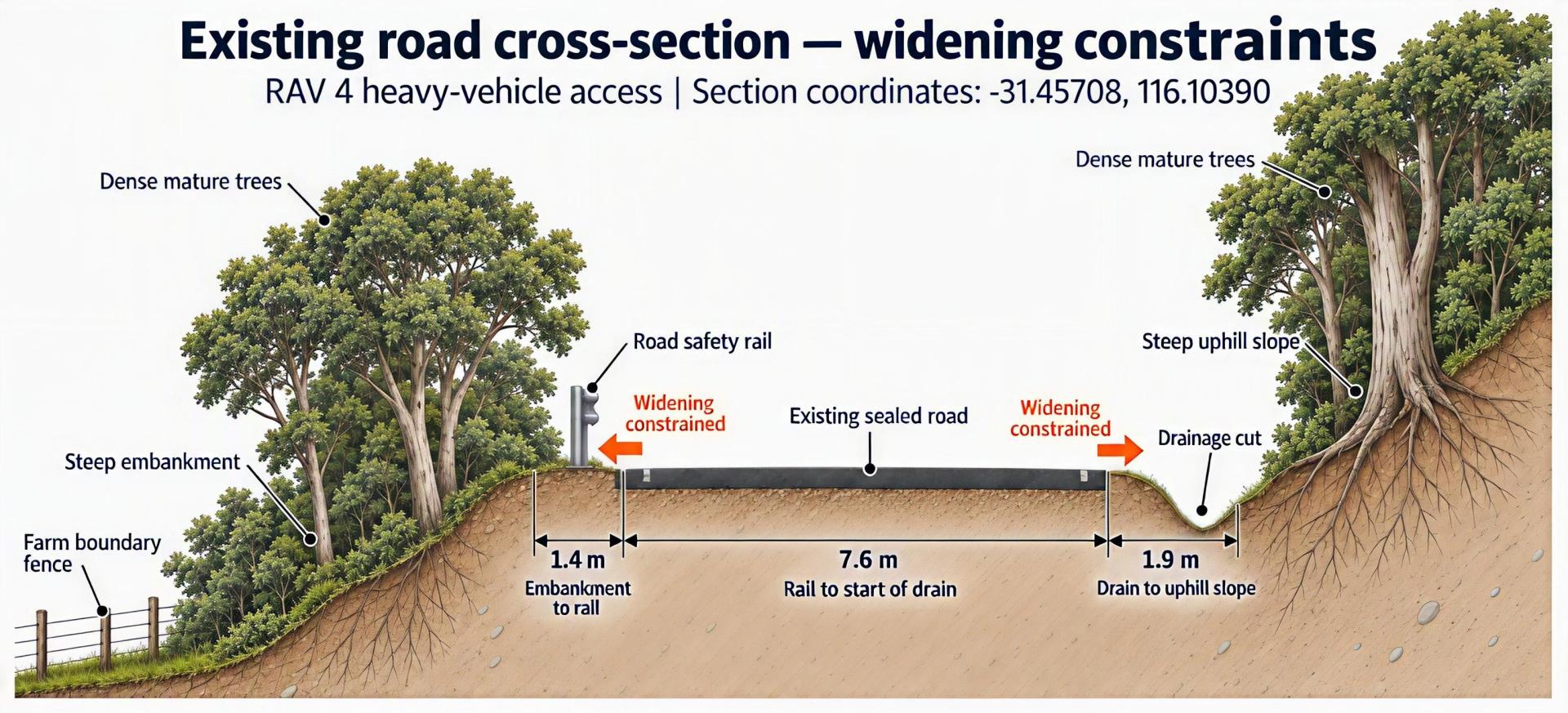
Indicative cross-section based on observations and approximate dimensions at one identified section of Chittering Road.
The diagram illustrates the types of physical constraints that may affect road widening.
It is not a surveyed engineering design, road-safety audit or determination of the works that would ultimately be required.
Has the Shire raised the environmental implications of using Chittering Road for freight?
Yes.
The Shire has asked for consistency in the treatment of environmental constraints. Information provided to the Shire identified sensitive flora and fauna as a constraint on locating project service infrastructure along Chittering Road.
The Shire has therefore asked how those constraints would be addressed if road widening, sightline clearing, drainage works, intersection upgrades or sustained mine-related heavy-vehicle movements were proposed along the same road corridor.
The Shire considers that direct, indirect and cumulative effects must be assessed together rather than treating truck movements separately from the physical works needed to enable them.
What is the Shire doing about road safety and emergency-management concerns?
The Shire recognises that significant project-generated traffic within Chittering could affect road safety, road condition, emergency access and local emergency planning.
The extent of those effects cannot be properly assessed without sufficiently developed information about routes, vehicle types and numbers, operating hours, dangerous goods and the full range of project-generated traffic.
As reliable information becomes available, the Shire can assess matters within its responsibilities and advocate to the responsible State agencies on matters within theirs.
The objective is to identify and address credible risks before intensive project traffic occurs, rather than establishing a duplicate approval system at Chittering ratepayers’ expense.
Will Chittering ratepayers have to pay for project-related road upgrades or damage?
Council’s position is that project-attributable costs should not be transferred to existing Chittering ratepayers.
The Shire has sought assurance that project-related capital works, maintenance, monitoring, rehabilitation and associated liabilities remain with the proponent and the State rather than being transferred to the Shire or its ratepayers.
If project traffic is proposed on Shire-managed roads, the Shire will require sufficient information to understand the effects and seek appropriate arrangements for necessary works and ongoing costs.
Affected landholders and community wellbeing
Does the Shire recognise the stress and uncertainty being experienced by residents?
Yes.
The Shire recognises that uncertainty about major infrastructure can have a significant personal effect, particularly for residents whose homes, properties and future plans may be directly affected.
The Shire’s role is to ensure consequences for affected Chittering communities are not overlooked and to advocate for appropriate consideration of social and community impacts.
This is different from the Shire attempting to make clinical findings about individual health impacts.
What is the Shire’s role in supporting affected landholders?
The Shire recognises that landholders who may be directly affected by proposed infrastructure face particular uncertainty about what the project may mean for their properties.
The Shire’s role is to advocate for affected Chittering residents and landholders, ensure their circumstances are recognised in relevant decision-making processes, and seek to avoid or minimise impacts wherever possible.
Property access, easements and other property-specific arrangements proposed by Chalice are matters for affected landholders to consider directly with the proponent and, where appropriate, their own independent advisers.
The Shire will not attempt to make those decisions for individual landholders. It will continue to act collectively by advocating for alternative alignments, avoidance of homes and sensitive areas, recognition of environmental and amenity impacts, and meaningful engagement with affected landholders.
Supporting affected landholders does not mean speaking for them. It means helping to ensure their interests are not overlooked.
Has the Shire asked Chalice to engage directly with the community?
Yes.
The Shire invited Chalice to participate in the community information-sharing night.
Chalice advised that it would not attend that public session and indicated a preference for direct engagement with affected landholders. Chalice also indicated that it would provide written information and respond in writing to matters arising from the session.
The information-sharing night will proceed as a Shire session explaining to our residents the matters within the Shire’s role and the actions it has taken.
The information-sharing night
Why is the Shire holding an information-sharing night?
The information-sharing night is being held so the Shire can give residents a clear account of the advocacy undertaken to date, the work continuing and the matters the Shire is still pursuing. It also provides an opportunity to bring the Shire and community together around a shared interest: achieving the best possible outcome for Chittering.
People may hold different views about the Gonneville mine itself. Those differences do not change the shared interest in protecting Chittering residents, affected landholders, the environment, local roads and the character of the Chittering Valley.
The Shire will share what it knows, what it has done, what it is seeking to achieve and what remains uncertain. Community members can share relevant information they hold that may assist the Shire and other residents.
The objective is to improve the information available to everyone, not to create an adversarial exchange between Council and the community.
What type of session will it be?
The information-sharing night is not a protest meeting, rally, formal Council meeting or public-question-time session.
There will be no motions from the floor, and the session will not determine a collective position on whether the Gonneville mine should proceed.
The evening is not structured around extended questioning of Councillors, Shire officers or other participants. Reasonable requests for clarification about information being presented may be addressed where practicable, but the focus will remain on sharing information rather than testing or challenging individuals through probing question-and-answer exchanges.
The value of the evening will come from the quality and relevance of information exchanged, not from the number of people attending in support of a particular position.
We may not all hold the same view about the mine itself, but when it comes to protecting Chittering and seeking the best outcome for our residents, landholders, environment and district, there is far more that unites us than divides us.
Is the information-sharing night a debate about whether mining should occur?
No.
The Shire understands that people hold differing views about mining generally and the Gonneville Project. Those views are respected.
The Shire does not determine whether the mine is approved and does not have a general policy position opposing mining.
The session will focus on Chittering: residents, affected landholders, potential cross-boundary concerns, proposed infrastructure and transport corridors, the environment, roads, community wellbeing, rural amenity, Shire assets and ratepayers, and the actions the Shire is taking.
The Shire will not speculate or speak on behalf of Chalice or State and Commonwealth regulators about matters for which those organisations are responsible.
The bottom line
In simple terms, what is the Shire’s position?
The Gonneville mine is outside the Shire of Chittering. The Shire is not the authority that decides whether the mine is approved, and Council does not have a general position against mining.
That does not mean credible concerns about potential cross-boundary effects from the mine should be dismissed. Residents and community organisations can raise mine-related concerns directly through the relevant State and Commonwealth processes. Where an issue has broader implications for Chittering, the Shire may also make its own submission or advocate independently for Chittering’s interests.
Infrastructure and transport associated with the project may also directly affect Chittering. Those impacts are a central focus for Council.
Council’s preferred outcome is for Gonneville-associated infrastructure and transport corridors to be located outside the Shire.
The Shire will continue advocating for:
- affected residents and landholders;
- alternative infrastructure and transport solutions, including fair assessment of eastern options;
- protection of environmental values and threatened flora;
- protection of the Chittering Valley’s rural landscape and amenity;
- exclusion of Chittering Road from the project’s transport corridor;
- proper consideration of road and community safety;
- recognition of the full physical footprint of required road works; and
- protection of Shire ratepayers from project-attributable costs.
- The Shire will remain engaged with the proponent and relevant government authorities. That engagement is not support for a particular proposal.
It is how the Shire seeks to influence decisions it does not ultimately control.